You know how this thing works. Shit rolls downhill and money rolls uphill
Tony Sorpano
Dung beetles are a group of scarab beetles belonging mainly to the family Scarabaeidae. Many of the best-known dung-rolling species belong to the subfamily Scarabaeinae. They are small insects that play an important role in ecosystems around the world.
They are particularly important in Africa, where large mammals such as elephants, rhinos, buffalo and antelope provide them with an abundant supply of dung.
Dung beetles have a highly developed sense of smell and can detect fresh dung from considerable distances. Once they locate it, they quickly begin feeding or preparing dung for reproduction.
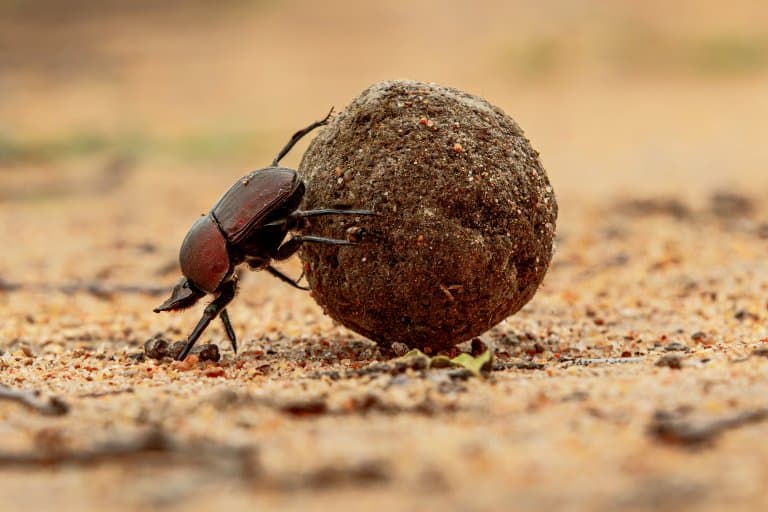
Some species are famous for rolling dung into balls. The beetle cuts a piece from the dung pile and shapes it into a compact ball using its legs and mouthparts. It then separates the ball from the main pile and begins moving it away.
The beetle positions itself with its head pointing towards the ground and uses its powerful hind legs to push the ball backwards. It may appear to be rolling around without direction, but it is actually navigating carefully.
Dung beetles use the sun, moon and patterns of light in the sky to help them travel in a straight line. This is important because other beetles may try to steal their dung ball. Getting away from the main pile quickly gives the beetle a better chance of keeping its food.
Once it reaches suitable ground, the beetle digs a hole and buries the dung ball. Some species use the buried dung as food, while others prepare it as food for their young
Female dung beetles may lay an egg inside a specially prepared dung ball. When the larva hatches, it has a ready supply of food surrounding it.
Not every dung beetle rolls dung into a ball. Different species have different strategies. Some bury dung directly beneath the original pile, while others dig tunnels underneath it and pull dung underground.
Their work has a major effect on the environment. By burying dung, dung beetles help return nutrients to the soil, improve soil structure and move organic material underground. Their activity can also reduce the amount of dung remaining on the surface and influence populations of other insects.
Some dung beetles are incredibly strong for their size and can move dung many times heavier than their own body weight.
Whenever I’m on a game drive, I get genuinely excited when I see dung beetles. It’s actually not that often that you come across them, which makes seeing them even more special.
A safari is about much more than the Big Five. The smaller animals and insects are just as much a part of the ecosystem, and dung beetles are a perfect example. They may not attract the same attention as an elephant or lion, but seeing one at work is a privilege.
They are fascinating animals, and they are also incredibly important. The next time you’re on safari and your guide stops for something small moving across the road, take a closer look. You might just be watching one of Africa’s most important recyclers at work.