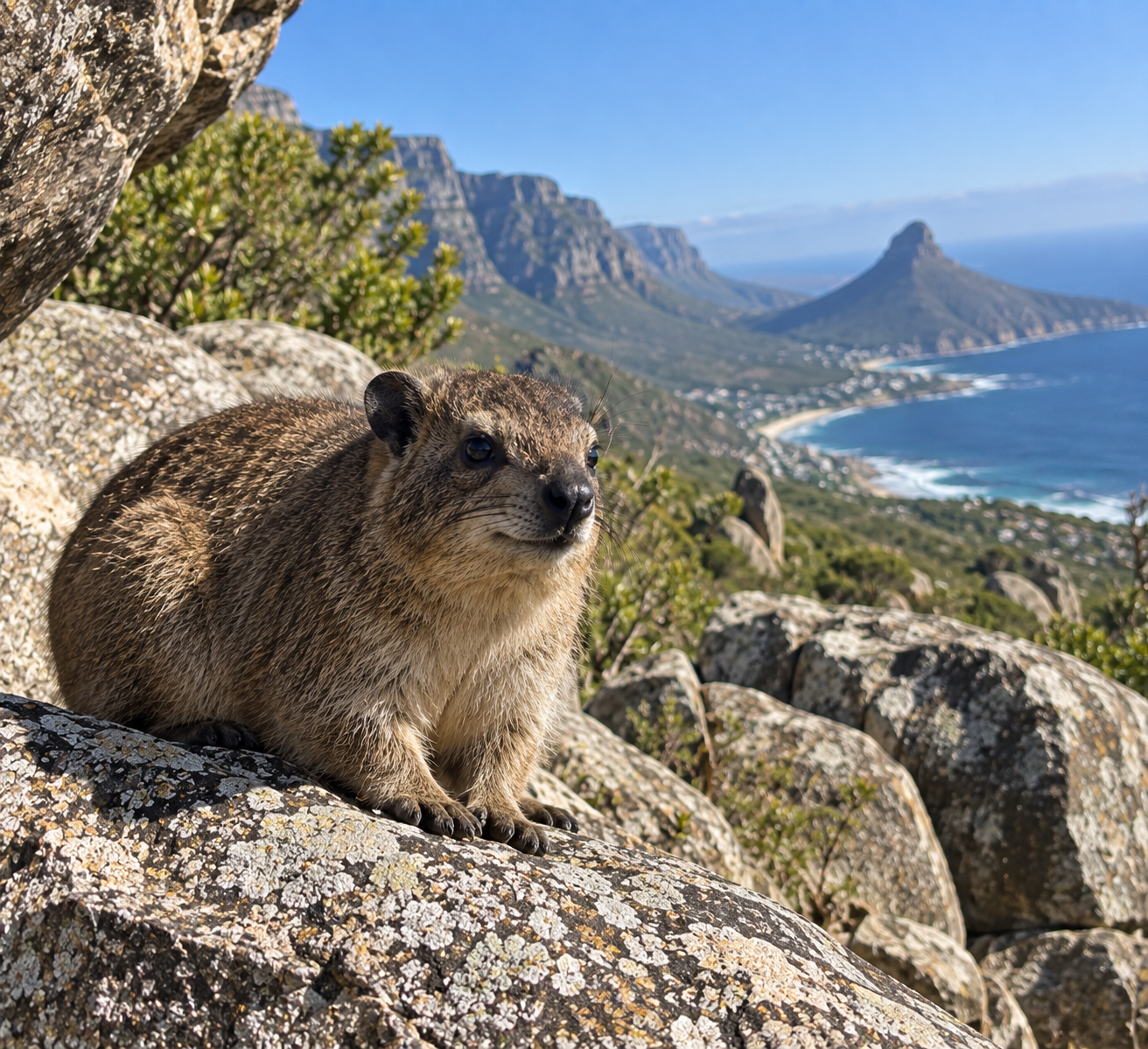
If you travel around South Africa, there’s a good chance you’ll eventually come across a Dassie.
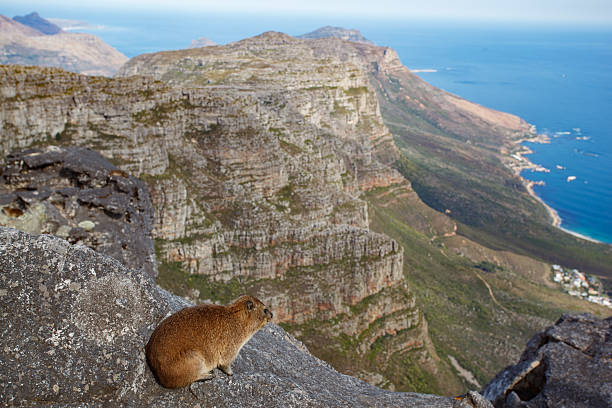
Their proper name is the rock hyrax (Procavia capensis), and they are found across large parts of Africa and into the Middle East. In South Africa they are particularly common around rocky hillsides, mountains, cliffs and coastal areas, where they can often be seen sitting in groups warming themselves in the sun.
At first glance, a dassie looks a little like a large guinea pig. They are compact animals with short legs, small ears and virtually no visible tail. Adults generally weigh somewhere between 2 and 5 kilograms.
One of the most interesting facts about dassies is their relationship to elephants.
Despite looking like rodents, hyraxes aren’t rodents at all. Along with elephants and sea cows such as manatees and dugongs, they belong to a larger evolutionary group called Paenungulata. Their common ancestor lived tens of millions of years ago, so saying a dassie is simply a miniature relative of an elephant is an exaggeration, but the evolutionary connection is real.
Dassies have several interesting adaptations. Their feet have soft, rubbery pads that help them grip rocky surfaces, making them excellent climbers. They also have continuously growing upper incisors which can give them an almost tusk-like appearance.
Another unusual feature is their ability to regulate body temperature. Dassies are not as efficient at maintaining a constant body temperature as many other mammals, which is why they spend considerable amounts of time basking in the sun.
They are social animals and usually live in colonies. While some members feed or relax, others may keep watch for predators. Their natural enemies include eagles, leopards, caracals and large snakes.
Dassies are mainly herbivorous, feeding on grasses, leaves, shoots and other plant material. They obtain much of the moisture they need from their food and can survive in surprisingly dry environments.
Where Will You See Dassies?
Pretty much anywhere there are rocks.
Around Cape Town, you’ll find them on Table Mountain, at Boulders Beach and throughout the rocky landscapes of the Cape Peninsula. Travel further around South Africa and you’ll continue to encounter them on mountainsides, around cliffs, in nature reserves and along rocky stretches of coastline.
Once you know what you’re looking for, they’re surprisingly easy to spot. Look for a group of small brown animals sitting motionless on rocks in the sunshine and there’s a good chance you’ve found them.
In places regularly visited by people, dassies can become extremely comfortable around humans. They may look harmless and approachable, but they’re still wild animals and shouldn’t be fed or handled.
They’re an animal most visitors know almost nothing about before arriving in South Africa.
Once you’ve seen a few, however, you’ll start noticing dassies everywhere.