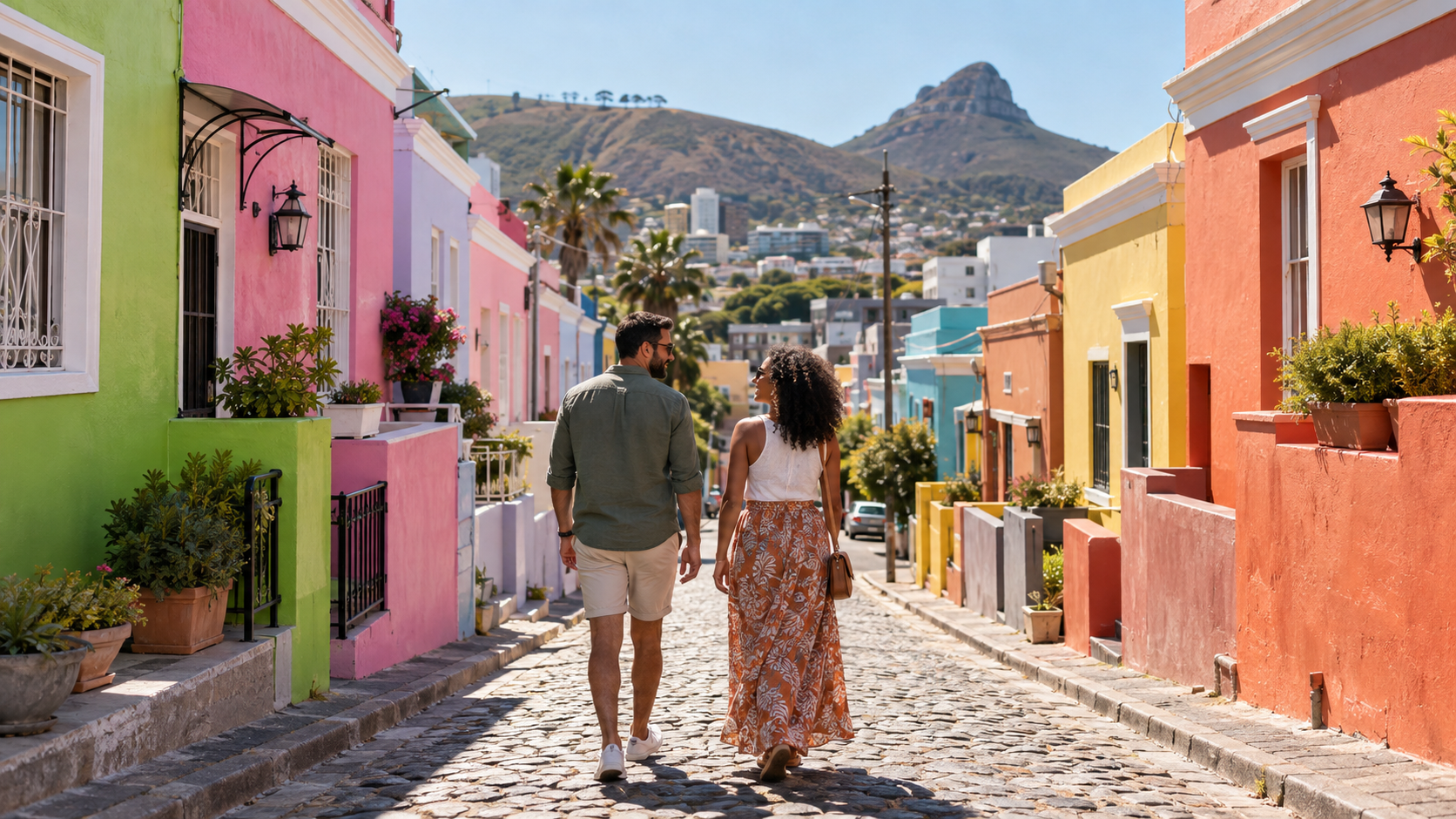
Bo-Kaap is one of Cape Town’s oldest residential areas. It lies on the lower slopes of Signal Hill, immediately above the city centre. Its name comes from Afrikaans and means “Upper Cape” or “Above the Cape.” The neighbourhood is known internationally for its brightly painted houses, cobbled streets and views across central Cape Town.
The area began developing during the eighteenth century. Many of its early residents were Muslims whose families had connections to enslaved people, political exiles and skilled workers brought to the Cape from Southeast Asia, India and other parts of Africa under Dutch colonial rule. These communities played an important role in the development of Cape Muslim culture.
The term “Cape Malay” became widely used to describe this community, although its ancestry is much broader than Malaysia alone. Cape Muslim culture developed through the combination of different languages, traditions, foods and religious practices.
Bo-Kaap is home to several historically important mosques. The best known is the Auwal Mosque on Dorp Street, which was established in 1794 and is generally recognised as South Africa’s first mosque. It is closely associated with Imam Abdullah ibn Qadi Abdus Salaam, better known as Tuan Guru, an influential religious leader who had been imprisoned on Robben Island.
The Bo-Kaap Museum occupies a house dating from the eighteenth century. Its exhibits cover local domestic life, Islamic culture and the history of the neighbourhood. The area also contains some of Cape Town’s earliest surviving examples of residential architecture. Many houses feature Cape Dutch and Georgian influences, flat roofs and distinctive front steps known as stoeps.

Bo-Kaap’s colourful houses are now its most photographed feature. Different explanations have been offered for the colours, but no single origin story has been conclusively established. What is certain is that the bright streets have become an important part of the neighbourhood’s modern identity.
In 2019, the City of Cape Town approved a Heritage Protection Overlay Zone for Bo-Kaap. Nineteen sites in the area were also declared national heritage sites that year. These measures were introduced to help protect its architecture and cultural character.
Visiting Bo-Kaap Respectfully
Bo-Kaap is not a theme park or an outdoor photographic studio. It is a living neighbourhood where people worship, work, raise families and go about their daily lives.
Visitors should avoid blocking residents’ doors, steps, driveways and narrow streets while taking photographs. People should not be photographed at close range without permission, and private homes should never be entered unless the resident has invited visitors inside. Extra consideration should be shown near mosques, particularly during prayer times.
One of the best ways to understand Bo-Kaap is to take a walking tour with a local resident or community-based guide. Local guides can explain the neighbourhood’s history, religion, food and traditions with knowledge that cannot be gained from photographs alone.
Visitors can also support the community by eating at locally owned restaurants, buying from neighbourhood shops and paying fairly for local tours and experiences. Tourism is most beneficial when money remains within the area and the people who preserve Bo-Kaap’s culture are included in telling its story.