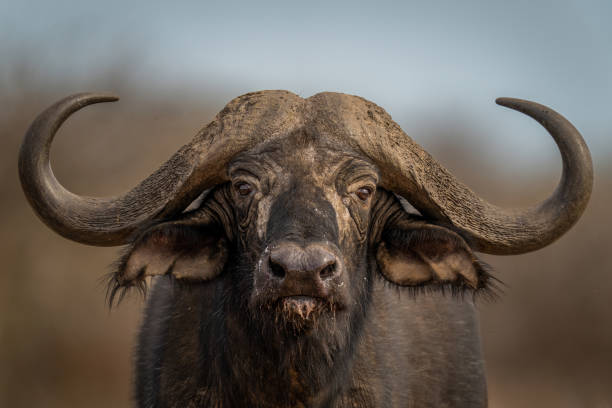
The Cape buffalo (Syncerus caffer caffer) is the large southern and eastern African form of the African buffalo. It is a wild member of the cattle family and one of Africa’s Big Five. Adult males can weigh more than 700 kilograms. Both sexes have horns, but those of mature bulls are generally heavier. In older bulls, the horn bases meet across the forehead to form a thick structure called a boss.
Cape buffalo inhabit grassland, savanna and woodland. They feed mainly on grasses and need regular access to water. Their distribution therefore depends on the availability of suitable grazing and drinking water. They are most often seen in herds, although older bulls may live alone or in small male groups.
Herds contain females, calves and males of different ages. Their size varies with habitat, season and food supply. Living in a group offers protection against predators, particularly lions. When threatened, buffalo may bunch together, flee or confront the predator. Adults have been observed attacking lions during attempts to take a calf. Lions nevertheless kill buffalo regularly, and buffalo are an important prey species for them in parts of southern Africa.
The Cape buffalo has a reputation for aggression, but its behaviour depends on the situation. An animal surprised at close range, separated from a herd, injured or defending a calf may charge. Its size, speed and horns make it capable of seriously injuring a predator. Lions hunting adult buffalo commonly work together because a single buffalo is difficult to overpower.
Buffalo spend much of the day grazing and resting. They may travel between feeding areas and water, and they often wallow in mud. Mud can help cool the animal and coat its skin. Oxpeckers are frequently seen on buffalo, feeding on ticks and other material in the coat.

Females usually give birth to one calf. The calf remains close to its mother and is able to follow the herd soon after birth. Young buffalo are more vulnerable to predators than healthy adults. Their survival is affected by food availability, disease and predation.
In South Africa, Cape buffalo can be seen in Kruger National Park and Addo Elephant National Park, as well as other protected areas. Addo’s population has a distinct conservation history. When the park was established in 1931, only about 30 buffalo remained in the area. The population subsequently increased under protection.
Buffalo can carry diseases including bovine tuberculosis and foot-and-mouth disease. These are significant considerations when animals are moved between reserves or when buffalo and livestock occupy neighbouring areas. In protected ecosystems, buffalo are also major grazers and a substantial source of prey for lions.
Cape buffaloes are called “widowmakers” because they have a high-risk reputation for killing big-game hunters, which famously leaves their spouses widowed. A problem that can be avoided if hunters just leave them alone, no?
You can see Cape Buffalo with us on the Garden Route Tour