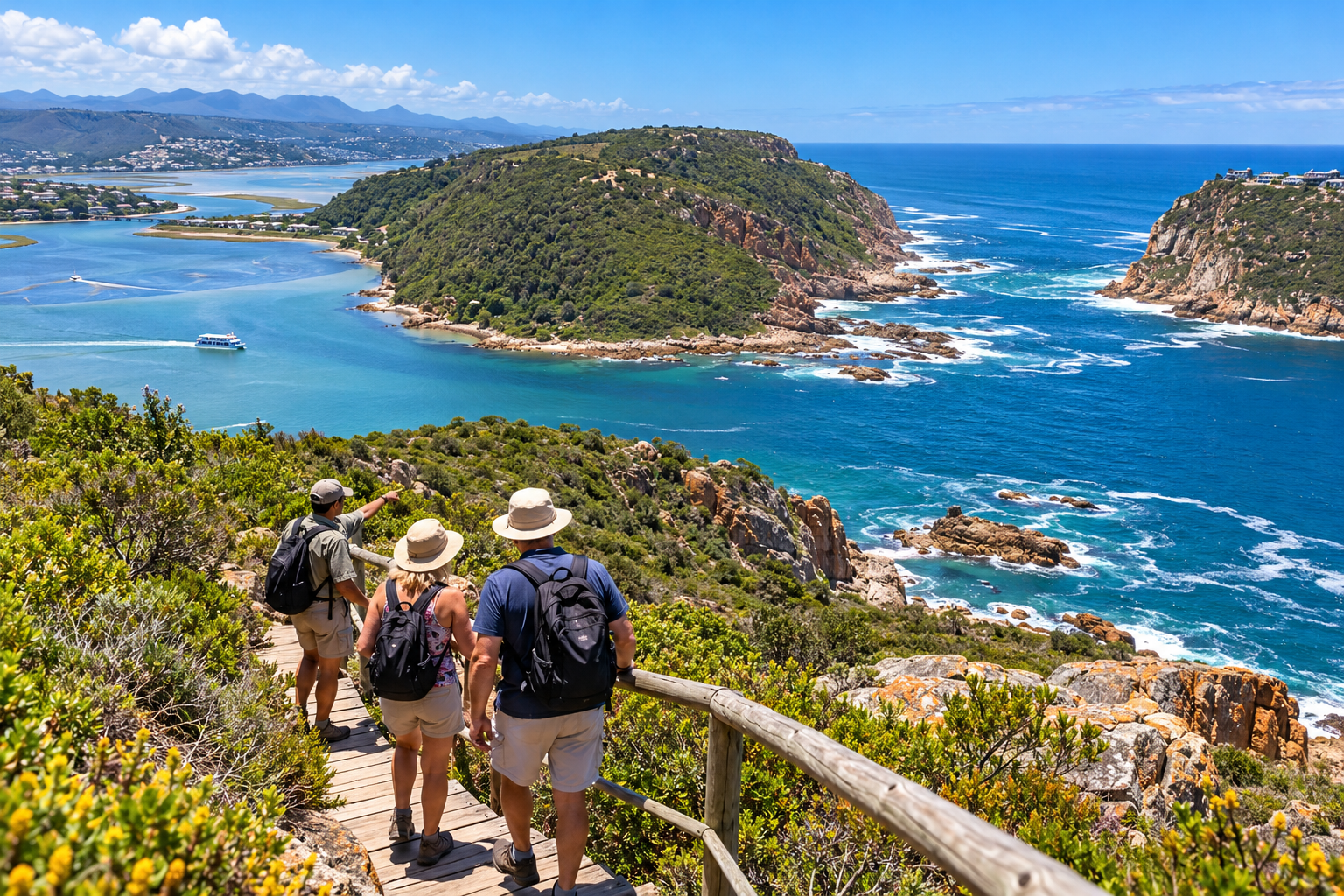
Situated on the western side of the famous Knysna Heads, Featherbed Nature Reserve is a privately owned nature reserve and one of the Garden Route’s established tourist attractions. Accessible only by ferry, the reserve offers visitors an opportunity to explore the coastline, indigenous vegetation and fascinating history of Knysna.
Getting to Featherbed Nature Reserve
The experience begins with a ferry journey across the Knysna Lagoon, departing from the Featherbed terminal near the Knysna Waterfront.
The lagoon is actually an estuary, where freshwater from surrounding rivers mixes with seawater entering through the narrow passage between the Knysna Heads.
After arriving at the reserve, visitors are transported up the headland in a specially adapted 4×4 vehicle and trailer. Along the way, there are stops at viewpoints overlooking the Indian Ocean, Knysna Lagoon and the surrounding Outeniqua Mountains.
Walking Through the Reserve
One of the main attractions is the optional 2.2-kilometre guided nature walk, which descends through coastal vegetation towards the shoreline.
The route passes through indigenous forest, fynbos and ancient sandstone formations. Visitors can also explore caves that provide evidence of human activity dating back thousands of years.
The walk is accompanied by knowledgeable guides who explain the area’s geology, vegetation, wildlife and history.
For visitors who prefer not to walk, the guided vehicle experience provides an alternative way to enjoy the scenery.
Wildlife and Indigenous Vegetation
Featherbed Nature Reserve protects an important section of Knysna’s coastal environment.
One of its most significant features is Knysna Sands Fynbos, a critically endangered vegetation type found in a relatively small area of the southern Cape.
The reserve also contains indigenous milkwood trees, coastal thicket and numerous species of flowering plants.
Birdlife includes species associated with the surrounding forests and coastline, while dolphins and migrating whales can occasionally be spotted in the ocean below the cliffs.
The reserve’s vegetation was affected by the devastating Knysna fires of 2017, making its continued recovery and conservation particularly important.
A Fascinating History
Featherbed has an interesting connection to one of South Africa’s most famous scientific discoveries.
The reserve was developed as a tourist attraction during the 1980s by William Smith, the well-known South African mathematics and science educator.
His father, Professor J.L.B. Smith, was the scientist who identified the coelacanth in 1938, a remarkable fish previously believed to have disappeared millions of years ago.
Professor Smith had a personal connection with the Featherbed area, which was one of his favourite fishing locations.
Archaeological discoveries on the reserve have also revealed evidence of human activity dating back more than 300,000 years.
Lunch Beneath the Milkwood Trees
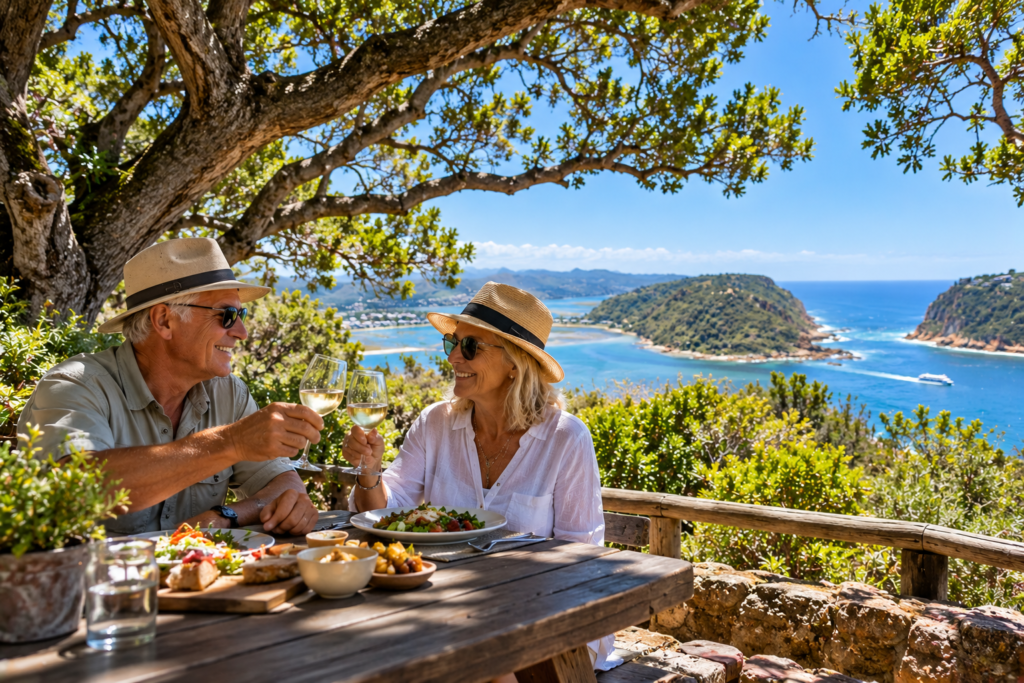
Visitors can choose an excursion that includes a buffet lunch served beneath a canopy of indigenous milkwood trees.
The full experience generally takes approximately four hours, while a shorter three-hour excursion without lunch is also available.
Featherbed Nature Reserve offers an interesting combination of natural scenery, coastal ecology, archaeology and local history, making it a worthwhile attraction to consider when spending time in Knysna on the Garden Route.