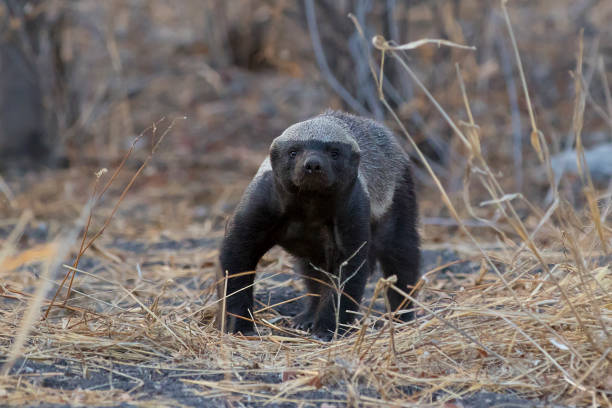
The honey badger, Mellivora capensis, is a carnivorous mammal belonging to the weasel family, alongside otters, ferrets and martens. Adults typically weigh between six and fourteen kilograms. They have short, powerful legs, a broad head and a stocky body. Their coat is black underneath, with a grey or white mantle extending over the head and back. Long claws on the front feet are used for digging, climbing and defence.
Its other name, ratel, comes into English through Afrikaans and South African Dutch. The precise origin is uncertain. Dictionaries identify two possible connections: the Dutch word raat, meaning honeycomb, and ratel, meaning rattle, referring to the animal’s vocalisations. Honey badgers produce several sounds, including grunts, growls, whines and a rattling roar during confrontations.
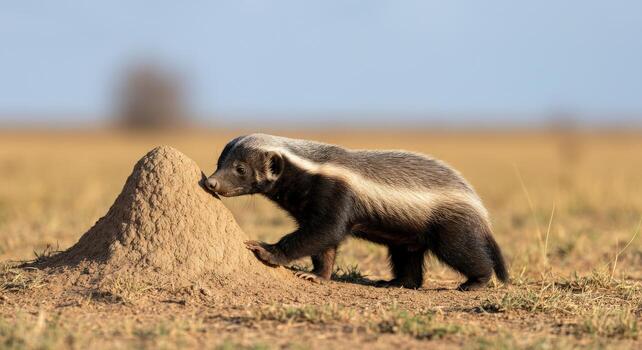
Honey badgers occur across much of sub-Saharan Africa, with populations extending through parts of the Middle East and into the Indian subcontinent. They occupy deserts, savannas, woodland, grassland and forests. In South Africa, wild honey badgers occur in the Kruger National Park and Kgalagadi Transfrontier Park. Their secretive behaviour and generally low population densities make sightings irregular. They often forage at night, although activity can shift towards daylight during colder weather.
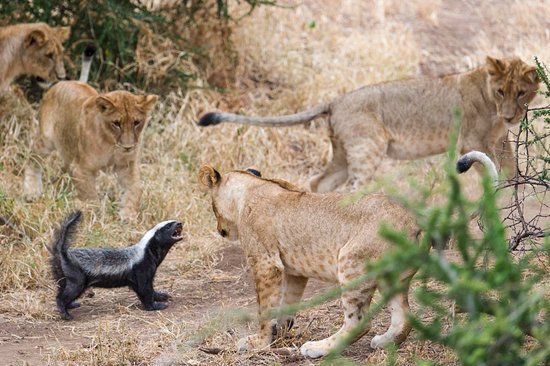
Their reputation for aggression is associated with vigorous defensive behaviour. When threatened, a honey badger can growl, charge and bite. Its thick, loose skin provides protection and allows it to twist around when seized, bringing its teeth towards an attacker. It also releases a strong-smelling secretion from anal glands. These glands serve both defence and scent communication. Despite these adaptations, honey badgers can be killed by larger predators.
Honey badgers hunt venomous snakes, including puff adders and cobras. Their diet also includes rodents, birds, lizards, scorpions, beetles and insect larvae. Researchers recorded more than sixty prey species in the southern Kalahari alone. They locate much of their food by smell, investigating burrows and digging prey out of the ground. Larger prey recorded in their diet include springhares, monitor lizards and young mammals.
They show resistance to some snake venoms, but this does not mean every bite is harmless. Researchers observed one honey badger suffer severe pain after a puff adder bit its face, then recover fully within five hours. Mothers have also been observed preventing young cubs from catching venomous snakes before they have developed the necessary hunting skills and coordination.
The name honey badger reflects its habit of breaking into beehives. Bee larvae are an important target, rather than honey alone. Honey badgers can climb trees to reach food and excavate resting burrows up to three metres long. They also occupy rock crevices, abandoned termite mounds and burrows made by other mammals.
Adults are usually solitary. Females generally raise a single cub without assistance from the male. Young remain dependent for many months while developing hunting and digging skills. In captivity, honey badgers have lived for up to twenty-six years. Their lifespan in the wild is less well established.