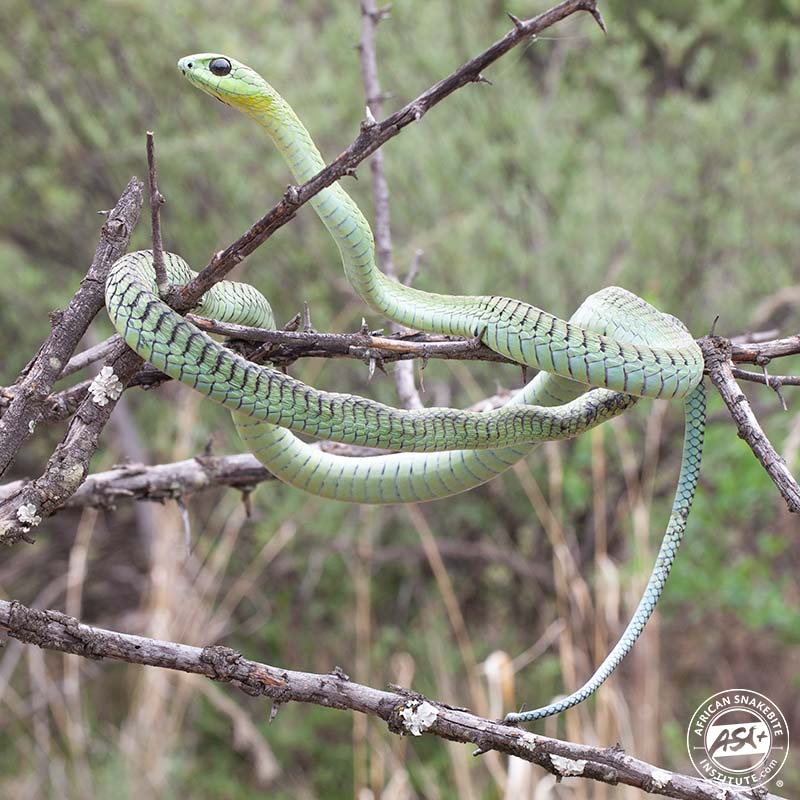
The boomslang is one of southern Africa’s most distinctive snakes. Its scientific name is Dispholidus typus, while “boomslang” comes from the Afrikaans words for “tree snake.” It occurs across much of sub-Saharan Africa and is found in several parts of South Africa, including the Western Cape, Eastern Cape and areas along the Garden Route.
Boomslangs are slender snakes that can reach approximately two metres in length, although most adults measure between one and 1.6 metres. They have large eyes, a blunt head and excellent daytime vision.
Their colour varies considerably. Adult males may be bright green, black and yellow, brown or occasionally reddish. Females are usually olive-brown or grey. Juveniles can look quite different from adults, with twig-coloured bodies, pale throats and distinctive green eyes. Their colouring provides effective camouflage among branches, leaves and surrounding vegetation.
I once experienced just how effective that camouflage could be while staying at a backpackers in the Eastern Cape. I was sitting on a balcony overlooking the sea when I noticed something in the bushes to my left.
There was a juvenile boomslang in a small tree, only a couple of feet away from me. Initially, I could hardly see it because it blended in so well with the vegetation. It was only when I moved closer that I realised the snake was there.
It was a beautiful snake, but because it was highly venomous and extremely close to the balcony, I informed the owners. They arranged for someone to remove it safely.
Boomslangs are primarily arboreal, meaning they spend much of their time in trees and shrubs. They are active during the day and use their excellent eyesight to locate prey. Their diet includes birds, nestlings, chameleons, lizards, frogs and occasionally small mammals.
The boomslang is highly venomous. Unlike cobras and mambas, it has its fangs towards the back of the upper jaw. However, it can open its mouth extremely widely and is fully capable of delivering an effective bite.
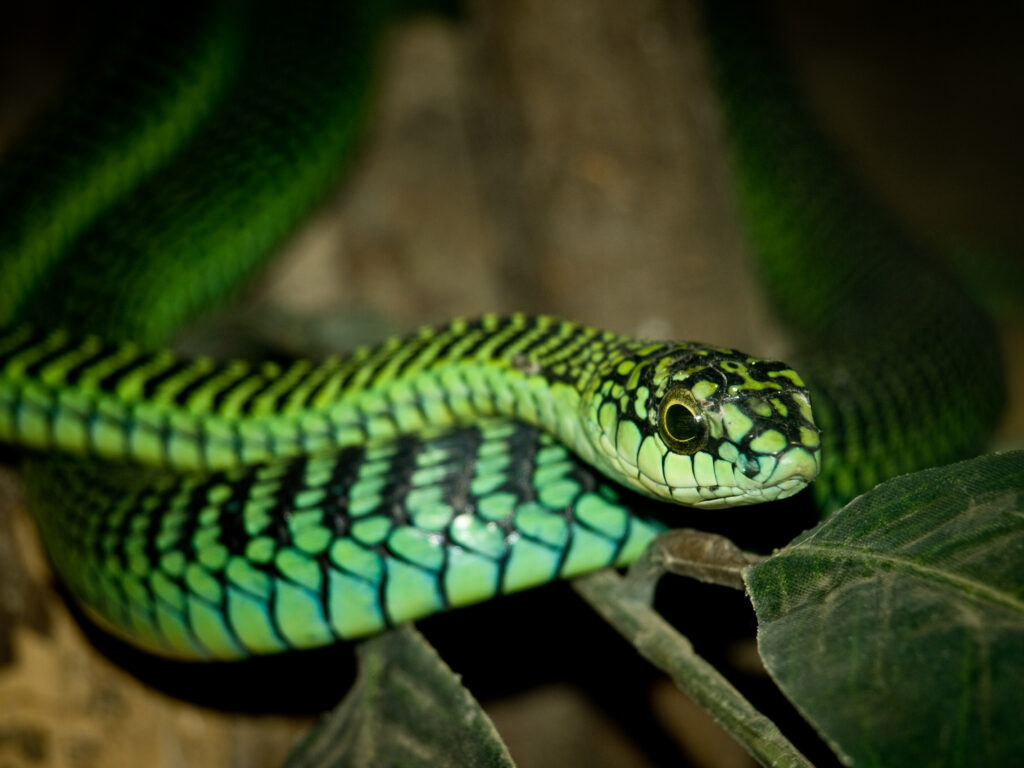
Its venom is haemotoxic, which means it interferes with the blood’s ability to clot. This can result in serious internal or external bleeding. Symptoms may be delayed, so a person can initially feel well after being bitten. Any suspected boomslang bite must therefore be treated as a medical emergency, and the person should be taken to hospital immediately.
Despite the strength of its venom, the boomslang is generally shy and will usually attempt to escape when approached. It does not hunt or chase people. Bites are uncommon and are most likely to happen when somebody tries to catch, handle or kill the snake.
If a boomslang is found near a home, hotel or public area, the safest response is to keep away from it and contact a trained snake remover. Attempting to catch or move it without the necessary experience creates unnecessary danger for both the person and the snake.
The boomslang is an important natural predator that helps control populations of birds, reptiles, amphibians and small mammals. It is currently classified as a species of Least Concern in South Africa. My encounter in the Eastern Cape remains a reminder of how easily this well-camouflaged snake can remain hidden, even when it is only a few feet away.