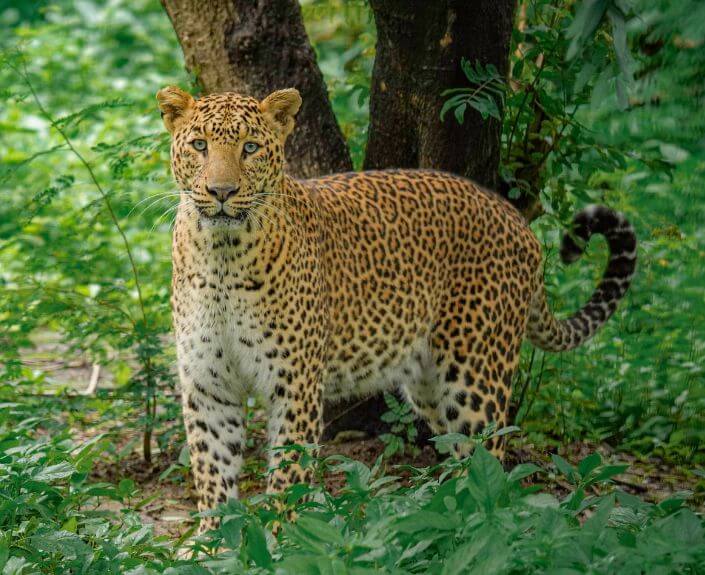
The leopard (Panthera pardus) is one of the most powerful, adaptable and secretive predators in southern Africa. Leopards live in an extraordinary variety of habitats, from the dry Kalahari and open savannah to woodland, mountains and forests.
They are primarily solitary animals and can be remarkably difficult to detect. Leopards can even survive relatively close to human settlements while rarely being seen.
Spots, Rosettes and the Difference from a Cheetah
A leopard’s coat is covered with distinctive markings called rosettes. These are irregular groups of dark markings, often surrounding a lighter centre, which help break up the outline of the animal and provide excellent camouflage.
Every leopard has an individual pattern of rosettes. Researchers can therefore use photographs and camera traps to identify particular animals.
This is also an easy way to distinguish a leopard from a cheetah.
Cheetahs have simple, solid black spots rather than rosettes. They also have distinctive black “tear marks” running from the inner corners of their eyes towards the mouth. Leopards do not have these markings.
Their bodies are also very different. Cheetahs are lightly built, with long legs and relatively small heads — adaptations for speed. Leopards are much more heavily built and muscular, reflecting their reliance on strength, climbing and ambush hunting.
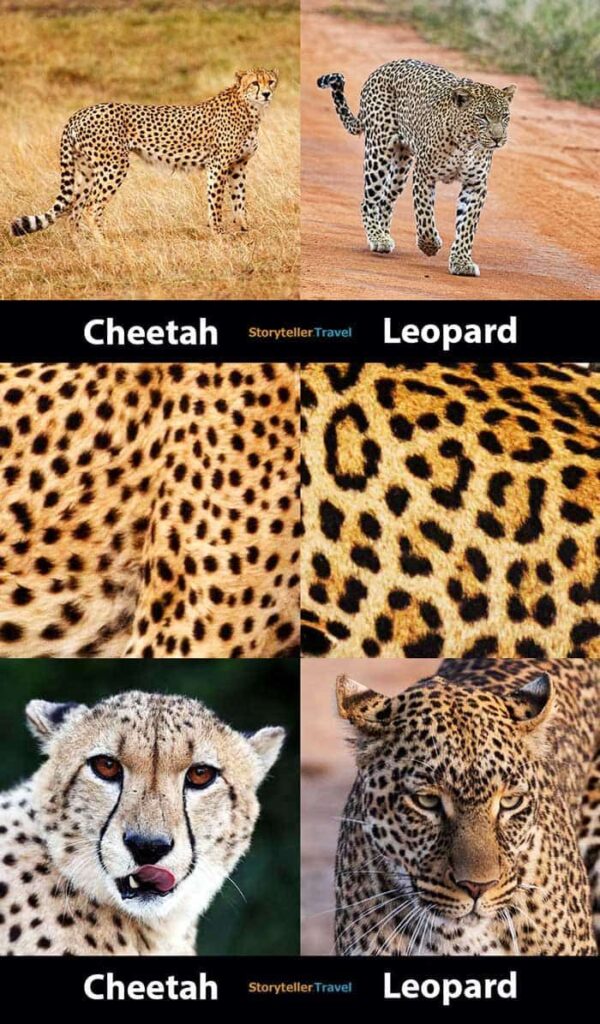
Leopard = rosettes, irregular dark rings/clusters with lighter centres.
Cheetah = solid black spots. Cheetah = distinctive black tear marks from the eyes towards the mouth;
Leopard doesn’t have them.
Cheetah = slender, long-legged, built for speed.
Leopard = heavier, muscular, built for strength, climbing and ambush.
Incredibly Strong
Leopards possess extraordinary strength for their size.
Their muscular shoulders, neck and forelimbs allow them to drag heavy carcasses and carry them into trees. Research in South Africa’s Sabi Sands has recorded leopards hoisting kills weighing approximately 40–140% of their own body weight. The South African National Biodiversity Institute has reported that a leopard’s powerful head and neck can enable it to hoist prey weighing as much as 125 kg.
This means a leopard can climb a tree carrying an animal heavier than itself.
Taking a carcass into a tree can protect it from scavengers and competing predators, particularly hyenas.
Leopards are superb climbers. Powerful limbs, retractable claws and a long tail for balance allow them to move through trees with remarkable agility.
A Leopard Cannot Be Domesticated
Leopards are wild animals and have never been domesticated.
An individual raised around humans can become habituated to people and may appear tolerant of familiar handlers. However, habituation is not domestication.
Domestication involves inherited changes produced through selective breeding over many generations.
A hand-raised leopard remains a wild predator. It retains its hunting instincts, territorial behaviour and enormous physical strength. Even an animal accustomed to humans has the physical ability to cause severe or fatal injuries.
Built to Hunt Alone
Unlike lions, leopards normally hunt alone.
They are ambush predators. Rather than chasing prey over long distances, they use vegetation, darkness and terrain to approach before launching a short, explosive attack.
Their diet in southern Africa is extremely varied and can include impala, duiker, bushbuck, dassies, porcupines, hares, rodents, birds and reptiles. Baboons may also be taken.
This broad diet is one reason leopards can survive in such different environments.
Reproduction
Leopards can breed throughout the year. Pregnancy lasts approximately three months, and females commonly give birth to two or three cubs.
The female raises her cubs without assistance from the male. Young cubs are kept concealed before gradually accompanying their mother and learning the skills required to hunt and survive.
Eventually, young leopards become independent and establish home ranges of their own.
Masters of Survival
Leopards have survived in parts of southern Africa where other large predators have disappeared.
Their ability to exploit different prey, survive in dramatically different habitats and move through landscapes almost unnoticed makes them exceptionally adaptable predators.
But they remain vulnerable to habitat loss, declining prey populations, persecution, illegal killing and conflict with livestock farmers.
The leopard is not built for extreme speed like the cheetah or cooperative hunting like the lion. Its success comes from a different combination of adaptations: extraordinary strength, camouflage, patience, climbing ability and stealth.